
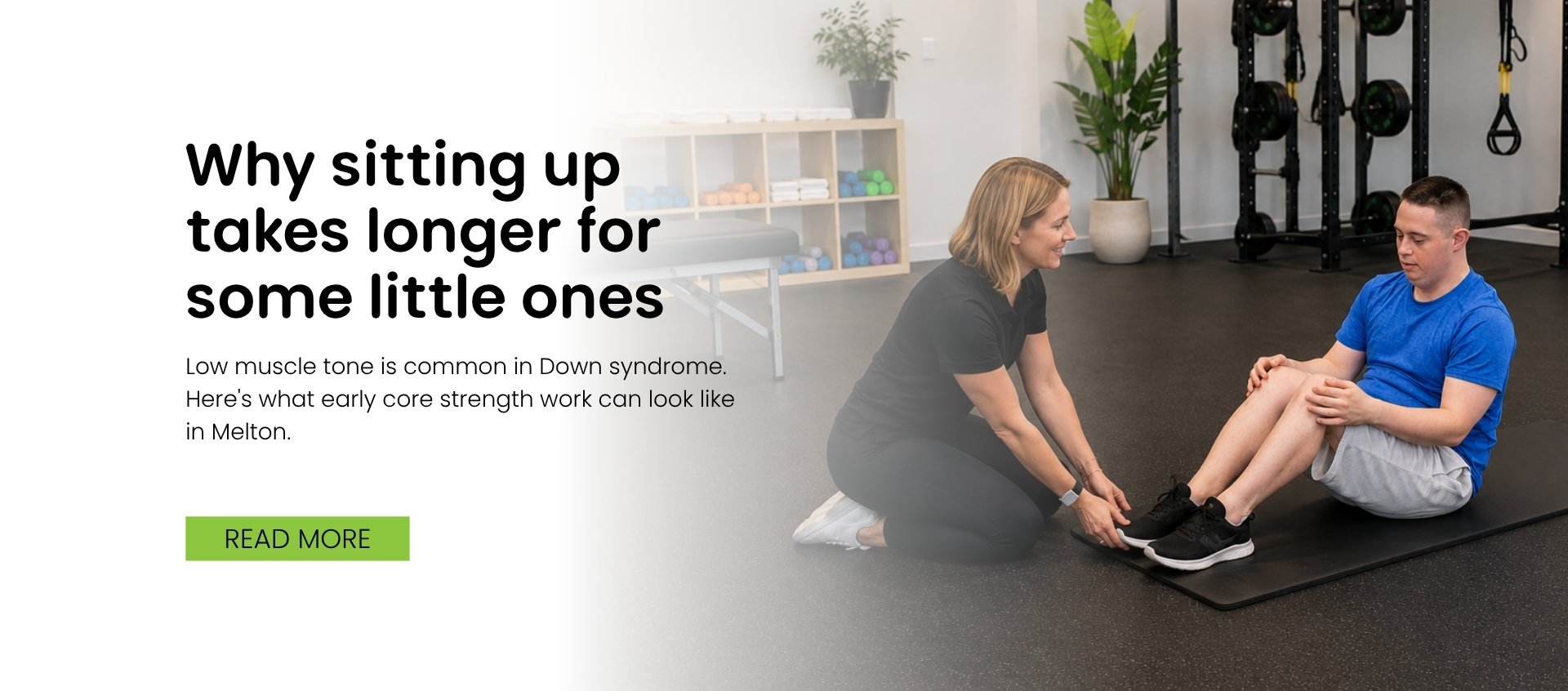
Rolling over, sitting up, pulling to stand. For many families these milestones arrive quietly and on their own schedule. For a child with Down syndrome, they often take longer, and low muscle tone is usually part of the reason.
Low muscle tone, also called hypotonia, is common in children with Down syndrome. It does not mean a child lacks effort or ability. It means the muscles that hold the body steady have to work harder, which can make core strength, balance and coordination slower to develop.
Down syndrome is the most commonly occurring chromosomal condition in Australia. Research summarised by Down Syndrome Australia estimates around 265 babies are born with Down syndrome here each year, roughly one in every 1,158 births. For families exploring down syndrome therapy Melton options, paediatric physiotherapy Melton services are often an early step, working alongside the care a child already receives from their GP or paediatrician.
What Low Muscle Tone Looks Like Day to Day
A systematic review in Clinical and Experimental Pediatrics notes that children and adolescents with Down syndrome commonly present with hypotonia, ligament laxity, reduced muscle strength and inadequate postural control. At home, that can show up as:
- Slumping or leaning to one side when sitting
- A wide, unsteady base when standing or walking
- Tiring quickly during floor play
- Difficulty holding a position while the hands are busy
This is where paediatric rehabilitation Melton services can help. A physiotherapist assesses how a child moves, then works with the family to set goals that matter in real settings: the loungeroom floor, kinder mat time, the playground.
Building Core Strength Through Play
Early strength work rarely looks like exercise. A paediatric exercise program Melton children can actually enjoy is usually built around play. Tummy time, reaching games, climbing, kneeling, balance tasks and floor transitions, repeated often enough to become familiar.
A meta-analysis published in Scientific Reports reviewed randomised trials of therapeutic exercise for children with Down syndrome aged 0 to 3 and found both aerobic and neuromuscular approaches were effective across outcomes including balance and motor development. The included studies were small, so results vary considerably between children, and no program can promise a particular outcome or timeline.
If you are not sure where to start, call the Healthstin Melton physiotherapy team on 1300 090 931 or contact us to talk it through.
A Team Approach, and Where NDIS Funding Fits
Children with Down syndrome are often supported by several professionals at once. At Healthstin, physiotherapy may focus on posture, strength and mobility, while exercise physiology can support ongoing activity and endurance as a child grows. Our allied health team shares goals rather than working in isolation.
For support coordinators, the NDIS early childhood approach covers children younger than 9 with delays in their development or disability, with separate early intervention requirements for children younger than 6 with developmental delay. Referrals for paediatric rehabilitation Melton supports can be made at any stage, and a paediatric exercise program Melton plan can be reviewed as a child's goals shift.
Choosing a Paediatric Provider in Melton
Whether you are a parent or a coordinator arranging supports, a few questions are worth asking:
- Does the provider have experience with Down syndrome and low muscle tone?
- Are goals written in plain language and reviewed regularly?
- Do therapists communicate with each other and with the family?
- Can sessions extend into home and community routines?
The Healthstin Melton clinic offers paediatric physiotherapy Melton appointments and down syndrome therapy Melton support in one place, which can reduce the number of trips families make each week.
Building core strength takes months rather than weeks, and every child follows their own path. Consistent, playful practice, supported by Healthstin Melton physiotherapy and a family who knows what to look for, is what tends to carry progress forward.
Ready to start? NDIS participants can book a free 30-minute consultation at no cost, or you can complete our referral form.
Ready to begin? You can book an appointment online or fill out our referral form, and our Melton team will contact you.
